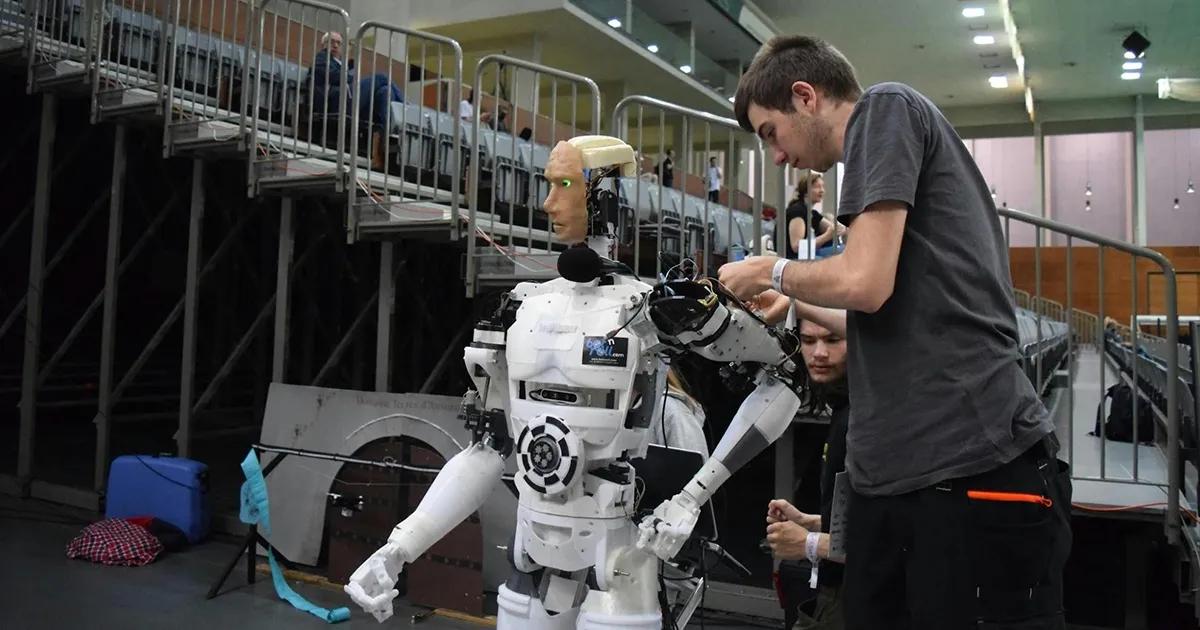


Humanoid robots are rapidly moving from research labs to factories, hospitals, warehouses, retail environments, and even homes. Companies around the world are making significant investments in robotic systems that can walk, manipulate objects, communicate naturally, and safely interact with humans.
But building a humanoid robot is only half the challenge. Extensive testing of software, hardware, artificial intelligence systems, and physical performance is required to ensure that the robot operates safely, reliably, and effectively in real-world conditions.
TL;DR
30-second summary
What does humanoid robot testing actually involve, and what does a structured validation process look like from initial investigation through to production deployment?
- Humanoid robot testing is a multidisciplinary process spanning six distinct validation domains. Simulation testing, LLM and AI integration validation, hardware and sensor testing, physical functional testing, stress and endurance testing, and production testing each address different failure modes and all are required before a robot can be safely deployed in real-world environments.
- Simulation environments are essential before physical testing begins. Testing directly on hardware is expensive, time-consuming, and potentially dangerous during early development. Platforms like Isaac Sim, MuJoCo, and Gazebo allow engineers to safely validate thousands of motion patterns, AI behaviours, and failure conditions in virtual environments before a single physical test run.
- AI and LLM integration testing is one of the most critical, and most complex, validation areas. Robots must correctly interpret voice commands, maintain environmental awareness, reject unsafe instructions, and continue operating safely when the AI misunderstands or partially fails. Hallucination prevention and safe decision-making under uncertainty are tested explicitly, not assumed.
- Sensor accuracy and synchronisation directly determine operational safety. Vision systems, LiDAR, IMUs, force and torque sensors, and audio systems must all be calibrated and synchronised precisely. Even small inaccuracies or delays between sensor inputs can affect balance, navigation decisions, and the robot's ability to safely interact with people and equipment.
- Safety validation is not a final gate, it runs throughout every stage of development. Collision avoidance, emergency stop systems, functional safety compliance, and AI safety constraints must be validated continuously as the robot evolves. Relevant standards include ISO 10218, ISO 13482, IEC 61508, and ANSI/RIA robotics safety guidelines.
Bottom line: Humanoid robot testing is far more than checking whether a robot can walk. It is a structured, multidisciplinary process that addresses mechanical reliability, AI behaviour, sensor accuracy, human interaction safety, and production readiness simultaneously. As robots become more autonomous and AI-driven, the rigour of that testing process is what determines whether they can be trusted in human environments.
What is humanoid robot testing?
Humanoid robot testing is the process of validating the functionality, safety, intelligence, durability, and reliability of a robot that resembles or mimics human movement and behavior.
Testing typically covers:
- Mechanical systems
- Embedded electronics
- AI and perception models
- Navigation and mobility
- Human-robot interaction
- Battery and power systems
- Sensors and actuators
- Production readiness
- Functional safety compliance
The goal is to ensure the robot performs correctly in controlled environments and unpredictable real-world scenarios.
TestDevLab humanoid robot testing
At TestDevLab, testers have the opportunity to work with the Unitree H1-2 humanoid robot, designed for future factory and industrial automation.
The team focuses on validating the robot’s movement, sensor systems, AI behavior, navigation, and safety in dynamic real-world environments. Testing includes obstacle avoidance, human interaction, environmental awareness, and emergency safety procedures to ensure reliable and predictable operation around people and other machines.
With the experience gained during this process, we will share insights throughout this blog on how humanoid robot testing is structured, implemented, and validated before deployment into production environments.

Understanding humanoid robots before testing begins
Humanoid robots vary significantly depending on their intended use case. Some robots are designed for industrial automation, while others focus on healthcare, logistics, customer interaction or research.
To better understand the different humanoid robot categories, architectures, and applications, we recommend reading our article: Introduction to Humanoid Robots: Types, Capabilities, and Future Impact.
Preparation phase and first investigation
Before testing begins, engineers and quality assurance teams first assess the humanoid robot platform and its operating environment. This preparatory phase is essential for developing an effective testing strategy.
During the initial investigation, teams review:
- Robot architecture and hardware specifications
- Sensor systems and AI capabilities
- Safety requirements and communication interfaces
- Intended use cases and operational workflows
The environment where the robot will operate also plays a major role in testing preparation. Whether the robot is designed for factories, warehouses, hospitals, or public spaces, each environment introduces different risks and validation requirements.
Teams additionally identify critical robot functions such as:
- Walking and balance stability
- Autonomous navigation
- Object handling
- Obstacle avoidance
- Human interaction and collaboration
A final part of this phase is risk assessment, where testers analyze potential mechanical, electrical, and safety hazards before creating the full testing and validation plan.
Simulation testing and LLM learning
The development of modern humanoid robots increasingly relies on simulation environments and artificial intelligence model training before physical implementation. Simulation significantly reduces development costs, speeds up testing cycles, and reduces the risk of hardware failures.
Why simulation is important
Testing directly on physical robots can be:
- Expensive - physical humanoid robots are expensive to operate and repair. A single mistake or collision can damage motors, sensors, or mechanical components.
- Time consuming - testing on real hardware requires setup, charging, calibration, supervision, and physical space, which slows down development cycles.
- Dangerous - humanoid robots can fall, collide with people, or behave unpredictably during early development stages, creating safety risks for engineers and testers.
- Limited by hardware availability - teams may only have access to a small number of robots, making parallel testing difficult and reducing testing speed.
Simulation solves many of these problems by allowing engineers to safely test thousands of motion patterns, AI behaviors, environmental conditions, and peripherals in a virtual environment before deploying real hardware.
Common simulation platforms
Different simulation platforms are used depending on what the robot’s purpose is, testing requirements and development stage.
- Gazebo - used in robotics research and ROS (Robot operating system) based development. Best suited for testing robot navigation, sensor integration, and real-world physics simulation.
- Isaac Sim - used for AI training, autonomous robotics, and industrial automation. Known for high-quality physics simulation, synthetic data generation, and advanced GPU powered environments.
- Webots - popular in education and prototyping. Useful for fast testing of robot behavior, movement, and multi-robot environments.
- MuJoCo - used in reinforcement learning and humanoid robot research. Best suited for precise movement dynamics, balance testing, and artificial intelligence movement training.
- Unity - used for realistic visual simulations, human interaction scenarios, and digital twin environments with advanced graphics and customization.
These platforms help simulate physics, gravity, sensor behavior, motion dynamics, and complex environmental interactions before testing on physical robots.
Types of simulation testing
Simulation testing helps validate how humanoid robots behave before entering real-world environments.
Key areas include:
- Mobility simulation - testing walking, balance recovery, stair climbing, and terrain adaptation.
- Manipulation simulation - validating robotic arm movement, grip control, dexterity, and pick-and-place tasks.
- Environment interaction - simulating crowded areas, dynamic obstacles, lighting changes, slippery surfaces, and other real-world conditions.
LLM learning and training AI models
Large language models (LLMs) are becoming an important component of modern humanoid robots, helping them improve communication, decision-making, and interaction with humans.
LLMs enable robots to understand spoken instructions, interpret user intent, plan tasks, generate contextual responses, and support autonomous actions. These AI systems are particularly useful in environments where robots need to collaborate with humans and adapt to changing situations in real time.
Testing AI and LLM integration

Integration testing of artificial intelligence and large language models (LLMs) is a critical part of humanoid robot validation. Because these systems influence how a robot communicates, makes decisions, and responds to its environment, testers must ensure that the AI behaves safely, accurately, and predictably in real-world situations.
AI testing focuses on areas such as response accuracy, command interpretation, latency, multi-step reasoning, and hallucination prevention. Testers validate whether a robot can correctly understand voice commands, maintain environmental awareness, and safely respond to unexpected situations.
One of the most important parts of validation is ensuring that the robot can reject unsafe or harmful commands and continue to operate safely even if the AI misunderstands the instructions or fails in some way. This includes testing the robot’s behavior around people, obstacles, confined spaces, and sensitive equipment. Simulation environments are typically used to train and validate AI behavior before it is implemented in physical robots. These virtual environments allow engineers to safely test thousands of interaction scenarios, peripherals, and failure conditions without the risk of hardware damage or security incidents.
Need to validate AI and LLM behaviour in a physical robotic system?
Hardware and sensor testing
Hardware validation is one of the most demanding parts of humanoid robot testing. Humanoid robots contain highly complex electromechanical systems that must operate reliably under continuous motion and environmental stress.
Major hardware components
Hardware testing ensures that the humanoid robot can operate reliably, safely, and continuously in real-world conditions. Engineers validate actuators, motors, power systems, batteries, and embedded electronics to confirm that the robot can perform movements accurately while handling physical workloads over long periods of time.
Testing focuses on movement precision, torque performance, heat generation, load handling, battery stability, charging behavior, and power efficiency. Teams also verify how the robot behaves during intensive operation, unexpected shutdowns, or power-related failures.
Additionally, embedded systems and low-level control software are tested to ensure robust real-time communication between sensors, processors, motors, and control units. This helps ensure that the robot can respond quickly, maintain balance, and safely execute commands during operation.
Sensor testing
Sensors are one of the most important components of humanoid robots because they allow the robot to understand and react to its environment. Testing focuses on validating how accurately and reliably the robot can detect objects, measure distance, maintain balance, recognize speech, and interact safely with people.
Engineers test vision systems for object detection, depth perception, motion tracking, and performance under different lighting conditions. LiDAR and distance sensors are validated for mapping accuracy, obstacle detection, and navigation reliability, while IMUs help ensure stable balance estimation and movement tracking.
Force, torque and tactile sensors are particularly important for safe human interaction, object handling and collision detection. Audio systems are also tested to verify speech recognition, noise filtering and directional sound processing in noisy environments.
A key part of sensor validation is calibration and synchronization. Even small inaccuracies or delays between sensors can affect a robot’s movement, decision-making and operational safety.
Physical and production testing
Once simulation and hardware validation are completed, robots undergo real-world physical testing. This phase determines whether the robot can operate reliably outside controlled laboratory environments.
Physical functional testing
Physical functional testing validates how the humanoid robot performs real-world tasks and interacts with its environment. Engineers evaluate the robot’s mobility, stability, object handling, and ability to safely work alongside humans.
Testing includes walking and balance validation, recovery from disturbances, speed consistency, and movement across different surfaces. Manipulation testing focuses on object handling, tool usage, repetitive workflows, and precision-based tasks that the robot may perform in industrial or service environments.
Human interaction testing is also critical. Teams validate safe operation around people, gesture and voice recognition, collaborative workflows, and the robot’s ability to react predictably in shared spaces.
Stress and endurance testing
Stress and endurance testing helps verify whether humanoid robots can operate reliably over long periods of continuous use. Since many robots are designed for factory, warehouse, or service environments, they must maintain stable performance during repetitive and demanding tasks.
Testing typically includes continuous operation cycles, repetitive movement validation, joint wear analysis, thermal stress testing, and shock or vibration resistance. Engineers monitor how components behave under extended workloads to identify mechanical weaknesses, overheating issues, performance degradation, and long-term reliability risks before deployment.
Production testing
Production testing ensures that each humanoid robot meets quality, safety, and performance requirements before it is deployed in a real-world environment.
During this phase, engineers validate functional behavior, sensor calibration, software configuration, hardware integrity, safety systems, and overall manufacturing quality. Testing also verifies assembly compliance, electrical safety, connectivity, firmware stability, and operational reliability across all manufactured units.
After installation, robots are further tested in a customer or production environment to confirm proper integration, environmental compatibility, workflow performance, and operator readiness. This phase is essential to ensuring that the robot can operate safely and reliably at commercial scale.
The importance of safety in humanoid robot testing
Safety is one of the most critical parts of humanoid robot testing. Unlike traditional industrial robots that operate in isolated environments, humanoid robots are designed to work close to people, which introduces additional safety risks and operational challenges.
Testing focuses on ensuring the robot can behave predictably, avoid unsafe actions, and safely respond to unexpected situations or failures. A malfunctioning humanoid robot can potentially cause human injury, equipment damage, operational downtime, regulatory issues, and loss of user trust.
As humanoid robots become more autonomous and AI-driven, safety validation becomes increasingly important throughout every stage of development and deployment.
Key areas of safety validation
Safety validation ensures that humanoid robots can operate reliably and safely around people and equipment. Testing focuses on how the robot reacts during normal operation, unexpected situations, and system failures.
One of the most important areas is collision avoidance, where robots are tested for human detection, safe movement near people, contact force reduction, and emergency stopping behavior. Engineers also validate emergency stop systems, including physical E-stop buttons, software failsafes, and power isolation mechanisms.
Functional safety testing evaluates redundant systems, fault tolerance, recovery mechanisms, and how the robot transitions into safe states during failures. In addition, AI safety validation ensures the robot can make safe decisions, reject unsafe actions, allow human override control, and maintain responsible behavior during autonomous operation.
Safety standards and compliance
Humanoid robots may require compliance with standards such as:
- ISO 10218 - focuses on industrial robot safety, including emergency stops, protective systems, and safe robot operation in industrial environments.
- ISO 13482 - designed specifically for personal care and service robots, covering safe human interaction, collision prevention, and operational risk reduction.
- IEC 61508 - defines functional safety requirements for electrical and programmable systems, helping ensure robots can safely handle faults, failures, and unexpected conditions.
- ANSI/RIA robotics safety standards - provide additional safety guidelines for robot integration, risk assessment, and collaborative robotic systems.
Compliance testing helps manufacturers verify that robots meet industry regulations, reduce operational risks, improve reliability, and build trust before deployment into real-world environments.
Safety validation for humanoid robots requires expertise across AI, hardware, and real-world deployment conditions.
We help robotics teams build and execute testing strategies that cover the full validation stack, from simulation through to production readiness.
Challenges in humanoid robot testing
Humanoid robot testing is highly complex because these systems combine AI, mechanical engineering, real-time software, autonomous decision-making, and human interaction into a single platform.
Some of the biggest challenges include:
- Environmental variability - robots may behave differently depending on lighting conditions, floor surfaces, noise levels, weather, or crowded environments.
- AI unpredictability - LLM powered and AI-driven robots can sometimes generate unexpected responses, misunderstand commands, or behave unpredictably in unfamiliar situations.
- Hardware complexity - humanoid robots contain hundreds of moving components, advanced sensor systems, embedded electronics, and high-performance processors that must work together reliably.
- Real-time constraints - robots must process sensor data, make decisions, and react instantly while maintaining stable and safe operation around people.
These challenges make continuous testing, validation, and safety verification essential throughout the entire robot development lifecycle.
Future of humanoid robot testing
The future of humanoid robot testing will increasingly rely on:
- AI-driven test automation - integrates artificial intelligence and machine learning into software testing.
- Digital twins - a dynamic, virtual copy of a physical object, process, or system that uses real-time data from sensors to simulate, monitor, and optimize performance.
- Reinforcement learning - a machine learning paradigm in which an autonomous "agent" learns to make decisions by interacting with a dynamic environment to maximize cumulative reward.
- Cloud robotics - the intersection of robotics and cloud computing, allowing physical robots to offload intensive processing, storage, and communication tasks to remote servers.
- Continuous simulation pipelines - automate the execution, testing, and evaluation of physics, logic, or system models by integrating simulation environments directly into the standard code delivery lifecycle.
Testing frameworks will evolve to validate not only mechanical performance but also cognitive intelligence and human collaboration capabilities.
As humanoid robots become more common across industries, robust testing methodologies will play a critical role in ensuring safe and scalable deployment.
Final thoughts
Humanoid robot testing is far more than simply checking whether a robot can walk or move its arms. It is a multidisciplinary process involving software validation, AI verification, hardware reliability, sensor accuracy, production quality, and safety assurance.
From initial investigation and simulation to real-world deployment and production testing, every stage contributes to building robots that can safely and effectively operate in human environments.
As robotics and AI technologies continue to evolve, testing strategies must also advance to address increasingly intelligent and autonomous systems.

Co-financed by the European Union. Project "Next Generation Micro-factories". Contract No. 5.1.1.2.i.0/4/24/A/CFLA/003. Funded by the European Union and the European Union – NextGenerationEU. However, the views and opinions expressed are solely those of the author(s) and do not necessarily reflect the views and opinions of the European Union or the European Commission. Neither the European Union nor the European Commission bears responsibility for them.
FAQ
Most common questions
What is humanoid robot testing and what does it cover?
Humanoid robot testing is the process of validating the functionality, safety, intelligence, durability, and reliability of a robot designed to mimic human movement and behaviour. It covers mechanical systems, embedded electronics, AI and perception models, navigation and mobility, human-robot interaction, battery and power systems, sensors and actuators, and production readiness. The goal is to ensure the robot performs correctly in both controlled environments and unpredictable real-world scenarios, not just in ideal lab conditions.
Why is simulation testing important in humanoid robot development?
Testing directly on physical robots is expensive, time-consuming, and potentially dangerous during early development stages. Simulation environments allow engineers to safely test thousands of motion patterns, AI behaviours, and failure conditions without risking hardware damage or safety incidents. Platforms like Isaac Sim, MuJoCo, Gazebo, and Webots simulate physics, sensor behaviour, motion dynamics, and environmental interactions, giving teams validated baselines before any physical testing begins.
How is AI and LLM integration tested in humanoid robots?
AI testing focuses on response accuracy, command interpretation, reasoning across multiple steps, latency, and hallucination prevention. Testers validate whether a robot correctly understands voice commands, maintains environmental awareness, and responds safely to unexpected situations. Critically, robots must be able to reject unsafe or harmful commands and continue operating safely when the AI misunderstands instructions or partially fails. Simulation environments are used to test thousands of interaction scenarios before AI behaviour is implemented in physical hardware.
What safety standards apply to humanoid robot testing?
Four standards are most commonly referenced. ISO 10218 covers industrial robot safety including emergency stops and protective systems. ISO 13482 applies specifically to personal care and service robots, covering safe human interaction and collision prevention. IEC 61508 defines functional safety requirements for electrical and programmable systems, ensuring robots handle faults and unexpected conditions safely. ANSI/RIA standards provide additional guidelines for robot integration, risk assessment, and collaborative robotic systems. Compliance testing verifies that robots meet these requirements before real-world deployment.
What are the biggest challenges in humanoid robot testing?
Four challenges stand out. Environmental variability — robots may behave differently depending on lighting, floor surfaces, noise levels, or crowded conditions that are difficult to fully replicate in testing. AI unpredictability — LLM-powered robots can generate unexpected responses or behave inconsistently in unfamiliar situations. Hardware complexity — hundreds of moving components, sensor systems, and embedded electronics must work together reliably under continuous motion and stress. And real-time constraints — robots must process sensor data, make decisions, and react instantly while maintaining safe operation around people, leaving no margin for latency or processing failures.
We've tested humanoid robots in real-world conditions. Let's talk about yours.
From simulation and LLM validation through to sensor accuracy, safety compliance, and production readiness, we help robotics teams build testing strategies that hold up outside the lab.