AI integration services
Connect AI to the workyour team already does
Looking to optimize QA processes with AI? We help you figure out where AI actually fits within real QA workflows. We assess your pipeline, your bottlenecks, and your team's reality. Then we tell you exactly what AI can do for you, what it can't, and what's worth building first.
Join the group of Startups & Fortune 500 companies that care about quality.





The challenge
Most AI integration attempts in QA fail
The tools exist. The use cases are clear enough. What's missing is the experience to know which tools are worth pursuing, how to introduce them without breaking what already works, and where to start.
New tools launch constantly, vendors overpromise, and use cases that work for one company fail for another. Without deep QA context, evaluating what's real and what's marketing is a full-time job most teams can't afford to do properly.
AI tools that work in a demo environment regularly break down when introduced to a real pipeline. Inconsistent data, edge cases, legacy tooling, team workflows that weren't accounted for. The gap between promising and working is where most attempts fail.
Integrating AI into QA sits at the intersection of two specialisms. Most engineering teams are strong in one but not both, which means either the AI implementation is naive about testing realities or the QA team can't evaluate what's being built.
With so many possible use cases, most teams either try to do too much at once and lose focus, or wait for a clearer picture that never arrives. Knowing where to start, and why, requires experience most teams are still building.
Bring AI into your existing systems and workflows. Ask us how

What we do
AI integration consulting, built specifically for QA
We're not a software vendor pushing a product. We're an independent consultancy that helps engineering and QA teams navigate the AI landscape and make decisions that actually hold up in production.
AI landscape mapping
We survey the current AI tooling ecosystem relative to your stack and help you understand what categories of tools exist, what they're genuinely capable of, and which vendors are worth evaluating.
Feasibility assessment
Not every AI capability makes sense for every team. We assess your data maturity, toolchain compatibility, team skills, and process readiness before recommending anything.
Integration roadmapping
We build a sequenced, realistic roadmap, prioritized by impact and implementation cost, so you know exactly what to tackle first and why.
Hands-on implementation
We don't hand over a deck and leave. We work directly with your team to implement the integrations, configure the tools, and make sure they're embedded into your actual workflows.
Measurement & validation
We define success metrics before we start and measure against them after. If something isn't delivering, we say so, and we adjust rather than defend the original plan.
Team enablement
Your team needs to understand and own what we build together. We run workshops, pair with your engineers, and build internal documentation, so knowledge stays in-house.
Bring AI into your existing systems and workflows. Ask us how
Key outcomes
What changes when AI is integrated into QA
AI integration in QA isn't about replacing engineers or chasing a trend. It's about removing the structural limits that stop quality from scaling at the same pace as your product.


AI integration creates leverage. More coverage, more test generation, and more triage without increasing headcount. The engineers you have shift their focus from writing and maintaining tests to reviewing, analyzing, and making the calls that require real judgment.
Longer pipelines create pressure to cut corners on test coverage. AI-assisted test selection and prioritization lets your pipeline run leaner by running smarter, targeting what's most likely to break given each specific change, rather than executing everything every time.
Defects found in production cost significantly more than defects found in the pipeline. AI tools that surface anomalies, flag high-risk changes, and detect patterns in test history shift that balance, giving teams the signal they need earlier, when it's cheaper to act on.
Most release decisions are informed by experience and gut feel. AI integration replaces that uncertainty with measurable risk signals, so teams can move faster with a clearer picture of what they're shipping.
Maintenance overhead is one of the biggest hidden costs in QA. AI tooling that adapts to UI changes, flags redundant tests, and monitors suite health turns an ongoing burden into something largely self-sustaining.
One of the underappreciated risks of scaling QA is that critical knowledge lives in individual engineers. Well-integrated AI tooling, combined with solid documentation, makes your QA processes more transferable and more resilient to team changes.
Bring AI into your existing systems and workflows. Ask us how
Types of AI integration
Practical AI integration, engineered for real QA environments
Not all AI integrations are built the same way. We use proven integration patterns that fit into your current toolchain without replacing what works, so your team gets the benefits of AI without rebuilding your infrastructure from scratch.
- Non-invasive
API-based integration
We connect AI models and tools to your existing systems via REST or GraphQL APIs, no changes to your underlying infrastructure. The AI layer operates alongside what you already have, reading data and returning signals without touching your core toolchain.
Best for: Defect triage, test case generation, risk scoring, and any use case where AI augments an existing workflow without replacing the tool behind it.
- Event-driven
Webhook & event-driven integration
AI workflows are triggered automatically by pipeline events, like a PR merge, a test failure, a deployment, without requiring manual intervention. Results are pushed back into your existing tools in real time.
Best for: Flaky test detection, automated defect routing, post-deploy anomaly alerts, and any scenario where speed of response matters.
- Pipeline-embedded
CI/CD pipeline integration
AI is embedded directly at specific stages of your build and test pipeline. Pre-merge, post-deploy, or as part of a nightly regression run. Intelligent test selection, risk-based execution, and coverage analysis happen as part of your existing CI flow.
Best for: Test prioritization, change-impact analysis, and reducing full-suite regression runs without sacrificing coverage confidence.
- Sidecar / middleware
Sidecar & middleware integration
AI runs alongside your existing tools as a parallel service, intercepting data streams or test outputs without modifying the tools themselves. Your current setup continues to function exactly as before — the AI layer observes and enriches.
Best for: Self-healing test scripts, visual regression analysis, and environments where modifying existing tooling is restricted or high-risk.
- Data pipeline
Test data pipeline integration
Historical test results, defect data, and coverage metrics are fed into ML models that learn patterns over time, identifying which tests are most likely to catch real failures and where coverage is weakest relative to actual risk.
Best for: Risk-based test prioritization, coverage gap analysis, and defect prediction in teams with sufficient test history to train on.
- LLM-powered
LLM API integration
Large language model APIs, including OpenAI, Anthropic Claude, and open-source alternatives, are connected to your test generation, documentation, or triage workflows. Prompts are engineered specifically for QA contexts, and outputs are validated before entering your suite.
Best for: Test case generation from requirements or API specs, bug report summarization, and generating test data at scale.
Not sure which integration pattern fits your environment?
We'll assess your stack and recommend the right approach during the discovery call.
By the numbers
- 100%
- flexibility with no vendor lock-in
- 3×
- faster onboarding to AI tools versus self-directed implementation
- 50–70%
- faster regression cycles
- 40–60%
- less test maintenance
Honest evaluation
What AI offers QA, and what it doesn't
We tell you the truth about AI capabilities, including the limitations. Here's a straight assessment of the most common areas teams ask us about.
| Use case | Current fit | What's realistic | What it doesn't replace |
|---|---|---|---|
| Test case generation from specs | Strong fit | LLMs generate 60–80% usable test cases from structured requirements with light human review. | Human judgment on edge cases, domain-specific risk areas, and business context. |
| Visual regression testing | Strong fit | AI-driven visual comparison tools reduce false positives, speeding up reviews. | Subjective UX decisions and brand consistency still need a human eye. |
| Defect triage and classification | Strong fit | AI classifies bug reports, identifies duplicates, and routes issues, cutting triage time. | Root cause diagnosis for complex failures still benefits from experienced engineers. |
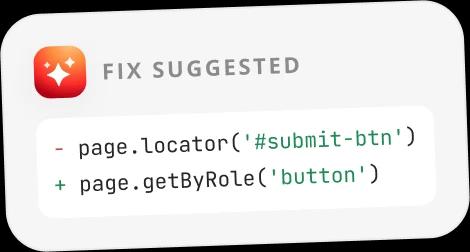
| Test script maintenance | Partial fit | AI detects and suggests fixes for broken locators and minor UI drift in stable codebases. | Logic-level changes and architecture shifts require hands-on engineer involvement. |
| Test prioritization | Partial fit | ML models trained on historical defect data can rank test execution by risk. Quality depends heavily on having enough clean historical data. | New features, new architectures, and first-time scenarios have no history to learn from. |
| Exploratory testing | Human-led | AI can suggest unexplored paths and surface anomalies in user journey data, useful as a co-pilot for exploration sessions. | The creative, domain-informed judgment that makes exploratory testing valuable remains deeply human. |
| UX & usability review | Human-led | AI can flag accessibility issues and identify surface-level UX patterns across large volumes of user interaction data. | Whether an experience feels natural, intuitive, or right for a real user. That judgment requires human perspective and domain empathy. |
| Security testing | Human-led | Automated scanning reliably catches known vulnerability patterns and common misconfigurations at speed and scale. | Discovering novel attack surfaces and reasoning about how a specific weakness could be exploited in your context requires an experienced security engineer. |
| Fully autonomous end-to-end QA | Not achievable | Current AI cannot reliably replicate the holistic judgment required for production release decisions on complex applications. | Human sign-off on release gates is non-negotiable for any production environment that matters. |
Not sure where your use cases fall? We'll give you a straight assessment for your specific stack. Book a call with an AI integration specialist

Who we work with
AI integration looks different depending on where you are
The AI integrations that make sense for a 10-person startup are rarely the ones that make sense for an enterprise QA team of 60. Scale, process maturity, toolchain complexity, and risk tolerance all change what's worth pursuing, and in what order.
Startups
Build the right foundations early
Early-stage QA is usually lean and fast-moving. We focus on targeted integrations that create immediate leverage, like test generation, basic CI optimization, and lightweight triage without requiring infrastructure or process maturity you don't have yet.
Scaleups
Scale QA without scaling the team
This is where QA debt compounds fastest. We focus on creating leverage. More coverage without more headcount, faster pipelines, and bringing test maintenance under control before it becomes a release blocker.
Enterprises
Integrate AI without disrupting what works
Large QA functions have different constraints, like compliance requirements, existing tooling investments, and distributed teams. We assess what's worth integrating given your infrastructure and help you build the internal case for change.
Not sure which category fits your team best?
Most companies sit somewhere in between. Let's figure it out together.
Our process
How we run an AI integration engagement
Most of our clients come in knowing something needs to change but unsure where to start. This is how we typically work through that together, from the first conversation to a running integration and beyond.
- 1
Discovery audit
We map your current QA process, toolchain, team structure, and pain points before making any recommendations.
- 2
Opportunity assessment
We identify which AI tools and workflows fit your stack, and which are overhyped for your specific context.
- 3
Hands-on implementation
We build alongside your team, starting with the highest-impact use case, with clear success criteria from day one.
- 4
Enablement & handoff
We run workshops, pair with your engineers, and document everything so your team can run the integrations confidently.
- 5
Ongoing support & maintenance
We stay available to monitor performance, handle updates as tools evolve, and extend integrations as your QA needs grow.


Not sure where to start with AI in your QA?
That's the most common place our clients start. Book a free 30-minute call. We'll tell you what we'd look at first for your context, with no commitment and no sales pitch.
Why clients choose us
We know QA. We know AI. We connect the two.
Most of our clients evaluated several options before reaching out. These are the things that made the difference.
Independent, vendor-neutral advice
We have no commercial relationship with any AI vendor. Our advice is based entirely on what fits your stack and your needs.
Years of hands-on QA experience
We integrated AI into our own practice first. Everything we suggest comes from direct experience running real QA engagements, not theory.
Honest about what's not worth building
A significant part of our value is helping clients avoid expensive mistakes—integrations that sound promising but don't survive contact with a real pipeline.
Hands-on implementation, not just advice
Every recommendation we make, we're prepared to build. Our job isn't done when the advice is delivered, it's done when the integration is working in your pipeline.
Measurable outcomes agreed from day one
We agree on success metrics before we start and report on them honestly at the end.
Full ownership handoff, no ongoing dependency
The goal of every engagement is a team that can run and extend what we built together, without needing us around to maintain it.
FAQ
Questions we get asked on every discovery call
AI integration in QA is the process of embedding AI-powered tools and workflows into your existing software testing and quality assurance processes. This can include using large language models to generate test cases from specifications, machine learning models to prioritize regression test execution, AI-driven visual comparison tools to reduce false positives, or intelligent anomaly detection to surface defects earlier in the pipeline. The goal is not to replace your QA engineers but to give them more leverage, handling the high-volume, repeatable work so your team can focus on the judgment-intensive testing that genuinely needs a human.
You don't need a mature AI setup or a dedicated ML team to begin. The most important inputs are a reasonably documented QA process, an existing test suite or testing workflow, and a team that's willing to engage with the implementation. From there, the discovery audit does the heavy lifting. We assess your data quality, toolchain compatibility, and process maturity to determine what's actually feasible before anything gets built.
Readiness isn't binary. The discovery audit is specifically designed to assess where your team is and what would be realistic to pursue given your current process maturity, toolchain, and data quality. We've helped teams at very early stages and at mature enterprise scale. The starting point is different, but the approach is the same.
This is one of the most common situations we encounter. Usually the issue isn't the tool, it's the fit between the tool and the environment it was introduced into. Part of what we do in the audit phase is understand what was tried, what failed, and why, so we don't repeat the same mistakes.
In most cases, no. Our goal is to integrate AI into what already exists, not to rip and replace. We design integrations around your current tooling and only recommend changes where they're clearly justified by the outcome.
Our engagements are designed to minimise disruption to your existing pipeline. We start in sandbox or staging environments, validate behaviour and results, and only promote changes into production once the integration is stable and your team is confident. Where possible, we use non-invasive patterns, connecting through existing APIs, CI/CD hooks, or alongside current tooling, so nothing in your live workflow is replaced until it's ready to be. If any operational impact is anticipated, it's identified during the discovery audit, communicated clearly, and scheduled to avoid active release cycles.
It depends on the use case and the starting point, but most clients see measurable impact from their first integration within 6–8 weeks of implementation starting. The discovery and roadmapping phase takes 2–3 weeks before any building begins.
Your team owns everything we built. We document all integrations thoroughly and run enablement sessions so your engineers can maintain and extend them independently. For clients who want continued support, we offer ongoing maintenance retainers, but they're optional, not a requirement.
What's next
Ready to find out where AI fits in your QA?
Most teams know AI should be integrated into their QA process. Few know exactly where to start. We help you find the right entry point, build it properly, and scale what works.