

If you're building a video platform—whether it's short-form video, live streaming, video conferencing, or VOD—you already know that startup latency is one of the hardest metrics to measure accurately on mobile. How long does it take from tap to first frame? How do you account for preloading, animation differences between apps, or degraded network conditions? And how do you automate measurements at millisecond precision when OS-level recording delays introduce their own latency?
At TestDevLab, we've spent over a decade measuring video playback latency for platforms used by billions of users daily—including benchmarking video startup, stalls, quality degradation, and scrubbing performance across Android and iOS. This post walks through the 7 specific challenges our QA engineers encounter when performing latency testing on mobile applications, and how we solve each one.
TL;DR
30-second summary
Latency testing is essential for understanding how fast your application responds to user actions — but getting accurate, reliable results on mobile is far from straightforward. Here are the 7 challenges QA engineers face most often:
- Automated vs. manual testing. Balancing speed of automation with manual validation to ensure result credibility.
- Determining the correct time to select a video. Animation differences across apps make pinpointing the exact selection moment tricky.
- Comparing different apps and platforms. Different user journeys and OS versions make apples-to-apples comparisons difficult.
- Dealing with network limitations. Restricted speeds cause unpredictable app behavior, stalls, and even crashes during testing.
- Testing different test scenarios. Cold startup, deep link, swipe, and upload each reveal unique performance gaps.
- Video and audio scrubbing. Identifying the precise moment a seek action starts and playback resumes requires careful automation.
- Latency in messaging applications. Multiple timed checkpoints and frame-by-frame analysis are needed to isolate true load times.
Challenge #1: Automated and manual testing

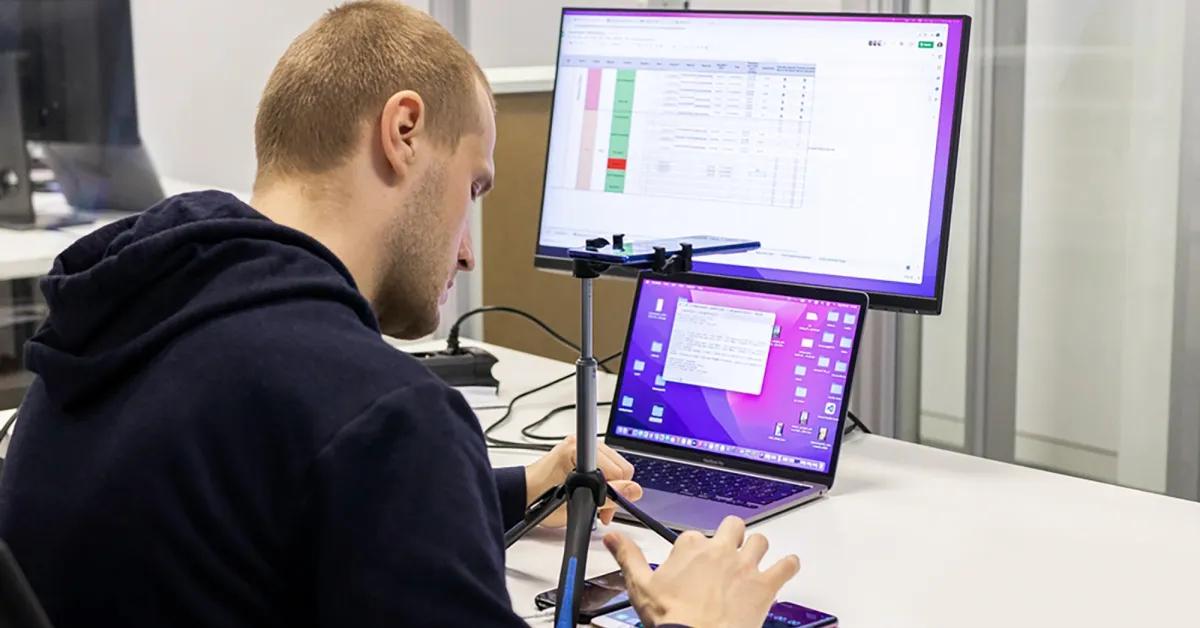
Latency testing typically involves two types of testing approaches—test automation and manual testing. When automating latency testing we need to validate the data to establish the credibility of our results. And that's where the tedious task of manually checking the results from the recording comes into play. We use a Quicktime or Elmedia player for validation to check the time it takes for the application to complete a desired action and compare it to the automated processing script results to see if it falls into specified deviation values. For example, if the deviation is 0.1 seconds, the difference between the manual check and automated script cannot exceed the value, and both negative and positive values are valid.
As the faith in the validity of our test results is established, validation can take a secondary role, and even be automated to catch failed cases that have slipped through the automation checks.
The main benefit of using automated tests for latency testing is the speed in which the tests are done. However, you need to review and tweak your test scripts to ensure they are credible. For manual testing, manual verification is done in the test process.
Challenge #2: Determining the correct time to select a video
One of the challenges of latency testing in mobile applications for video playback is determining when to select the video in order to get the most accurate result. The reason this is a challenge is because the animations for different applications are not the same, so it is hard for processing scripts to determine the correct time of selection and can lead to inaccurate results. Specifically, starting to record the test process as the video is selected can lead to milliseconds lost in the recording.
With the right approach to latency testing and measurements, this challenge can be overcome. Usually, we use one of two ways to decide when to select video. First, the recording can be started as the video is selected, and then the video start is determined by the movement of the video. The problem with this approach, however, is that the start of the recording can be delayed, making the latency times unreliable. The second way is to see when the device sends a command for the recording to start and for video to be selected. Using this approach, we can determine the length that needs to be trimmed from the test recording for it to start at the exact time the video is selected. We found that the problem with this approach is the time it takes for the device to send the command and for the command to be executed is too long for our latency testing purposes, as our aim is to achieve results with millisecond precision which is not possible with such an approach.
To overcome this challenge and determine the correct time to select a video, we can use a script to find a text on the page when a video is not selected and start the countdown for video startup latency as it disappears. It starts recording and finds a text visible on the screen at the start of the recording. Then, when the video is selected, it takes up the whole screen and the text has disappeared.
It is also valuable to know that in latency testing for mobile applications for video playback, there is more than just the number when the video starts to play. There can be stalls or dips in quality and applications can perform much worse in different network conditions. We can see an example of this below.
Challenge #3: Comparing different applications and platforms
Ensuring an apples-to-apples comparison between different applications can be a challenge when performing latency testing. This is because different applications have different user journeys, which makes it difficult to compare them accurately.
The same goes for comparing different platforms, such as Android and iOS, as they can have different application versions and, therefore, yield different results.
When presenting test analysis results, it is important to communicate the differences between operating systems and applications.
Suggested reading: Video Quality Comparison for H.264 at Different Resolutions and Bitrates
Challenge #4 Dealing with limitations
The best way to test latency is in a controlled and restricted network, as the application behavior can change drastically when the network is not ideal. We call these network limitations because we limit the network speeds to test different aspects of the application.
For example, with an internet speed of 1 megabit per second, it can take up to several seconds for the video to start or the video may fail to load altogether. Also, video stalling can become obvious as the video stutters as it loads. Application developers counter this issue by decreasing the video quality if they detect low network speeds.
Low network speeds do not only affect the test recording, but also the automated test process. For instance, elements can take too long to load or not load at all. Also, in our experience of latency testing, we have seen applications crash on lower limitations.
At TestDevLab, we recently developed the Netembox limiter, an access point that allows a limited network to be used in our test environments. This access point is used to test all sorts of devices and their performance under variable network conditions—which is a great solution to overcome limitations commonly experienced by QA engineers.
Struggling with network-dependent latency testing?
Our Netembox limiter and custom network simulation lab let you test video playback under controlled conditions—from 4G congestion to rural low-bandwidth. We can simulate your users' real-world conditions with reproducible results.
Challenge #5: Testing different test scenarios
To fully understand the difference between applications, it is important to consider different test scenarios and network limitations. Even applications that perform extremely well when the network is up to speed, may struggle when network conditions differ from usual, for instance, in crowded environments or when using applications in the countryside.
You might be interested in: How We Test Applications in Motion: Introducing Our Mobile Laboratory
We have derived four main test scenarios that we use for testing applications for video playback—cold startup, deep link, swipe scenario and upload.
Scenario #1: Cold startup
This test scenario focuses on video playback when the app is either freshly installed or all data has been cleared. The scenario is fairly simple: open the app, then find the testing profile, and finally open the video required for testing.
Performing this test shows us the time needed for applications to open and start playing the video. Also, we can see how the quality of the video differs on different network limitations, specifically what applications do to speed up the starting process.
The main challenge that we see in this test scenario is the application preloading videos, either starting to load the first video when visiting the profile page or in some cases even downloading the last video watched when the application is launched. But avoiding these behaviors can impact the performance of the tested app.
Also, the performance and startup latency can vary greatly depending on the operating system of the device, in our case Android or iOS.
Scenario #2: Deep link
Deep link is a way for us to test video applications in a way that prevents them from using any performance-enhancing tricks like preloading. It is a standard test used to understand the baseline performance of a video startup, ensuring that no cold or warm video startup is worse.
Deep link means that the link is opened in the application, not on the web. This scenario is even more simple, the only difference between this one and the cold startup scenario is that after launching the application, a link to the video is opened in the app and the video is played. For Android this is done fairly simply, by passing an adb command to open the deep link. To conduct a similar test on iOS devices, a custom app could be used to pass the link to the application.
Scenario #3: Swipe scenario
In swipe scenarios we test how well multiple videos start one after another by swiping to the next video after a set amount of time. Latency is recorded from swipe start to when the video starts to play. The amount of videos in the test can differ depending on the needs of the test, but we typically play 10 videos in a row to test the latency.
Scenario #4: Upload
For a good user experience, it is important to measure the time it takes for a video to be uploaded onto the application’s servers. The main challenge for this scenario is creating a clear way to determine when the upload has finished, as different applications can have very different ways of showing that the upload has been completed.
You might be interested in: Comparing Battery Usage Across Popular Video Call Apps
Challenge #6: Video and audio scrubbing
Scrubbing refers to the action of jumping forward during video or audio playback—but testing the latency of this feature can be challenging. To test this feature, we need to identify the moment when the motion to a different time slot in the video is initiated and then for the second point, we would use the point where the video resumes playing. With a precise, automated test process we could calculate the duration of the jump by treating it as a pause in the overall recording of the video playback.
Scrubbing is also useful for validating test results, as it helps identify the exact time when the video frames start to move.
Challenge #7: Latency in messaging applications

Measuring latency in messaging applications is another common challenge we frequently come across. To determine the latency in messaging applications, we need to establish the time lapse between two specific events. To calculate the time it takes for a message to fully load in the chat, we first need to calculate the time between the launch of the app and the time it takes for the app to fully load. Also, we need to note the time that has passed from clicking on the chat to when the message loads in the chat. This process aims to minimize the human effect on time, such as clicks and other actions. Times can vary and be subjective between different test engineers. A manual process is used for recording. Testers go through all events and record them on an external device. Recordings contain the full test flow including the actions that are dependent on the tester, called raw test videos.
In the analysis phase, each video is manually observed on the media player with the ability to go frame by frame and to observe timestamps with a precision of 1 millisecond. The QA engineer then proceeds to write down the timestamps of the action start and end times. The precision of the timestamp is from 1 to 2 frames (around 13 to 26 milliseconds on average). Time elapsed is then calculated automatically.
One of the main challenges of testing latency in messaging applications is variability. Namely, even for a single application there is not a specific time standard, especially if the network is limited. So every scenario has to be repeated several times to understand the overall trend.
When performing competitor analysis, a similar challenge is present. Not every application works the same and even the same application can work differently on different operating systems. So navigating them or their operations creates complexity in data analysis. It is very important to communicate the differences and nuances in them when doing the data comparison. The load times are dependent on the device, network restrictions, app navigation, and other factors.
Need to benchmark latency against competitors?
We run competitive video and messaging latency benchmarks for platforms serving billions of daily users. Get frame-by-frame analysis with millisecond precision across iOS and Android.
Key takeaways
In this article, we looked at the importance of latency testing and its challenges. We can conclude that latency testing is an effective way to determine the competitiveness and user experience of the software, as it shows the speed at which it responds to user actions or events after said actions.
The main challenges encountered by QA engineers when performing latency testing are related to network limitations and different network conditions, different test scenarios, and ensuring an apples-to-apples comparison between different applications, as their user journey can differentiate.
To overcome challenges related to network and user scenarios, QA engineers should test the mobile application under different network conditions and cover various testing scenarios.
Differences between comparable applications can be overcome with more complex data analysis and making sure the endpoints of the tests between different competitors are as close in operation as possible.
FAQ
Most common questions
What is video startup latency and why does it matter for mobile apps?
Video startup latency is the time between a user tapping play and the first video frame appearing. It directly impacts user experience and retention—even a few seconds of delay can cause viewers to abandon a stream, making it a critical performance metric for any video platform.
How does network speed affect video latency testing on mobile?
Limited network speeds can cause delayed video starts, buffering stalls, quality degradation, and even app crashes during testing. Testing under controlled network conditions—such as simulated 1 Mbps bandwidth—reveals how an app behaves in real-world low-connectivity environments.
What makes TestDevLab's latency testing different from in-house QA?
We bring over a decade of specialized experience benchmarking video playback for platforms used by billions of users daily. Our purpose-built lab infrastructure, proprietary tooling like the Netembox network limiter, and millisecond-precision automation deliver a level of accuracy and depth that's difficult to replicate with a general in-house QA team.
Can TestDevLab test my app's performance against competitors?
Yes. We run competitive latency benchmarks across multiple applications simultaneously, using identical devices, network conditions, and test scenarios to ensure fair, actionable comparisons. You'll get frame-by-frame analysis across both iOS and Android to see exactly where your platform stands.
Do you support testing under real-world network conditions?
Absolutely. Our Netembox limiter lets us simulate a wide range of network environments — from fast 4G to congested urban networks and rural low-bandwidth conditions — so you can see how your app performs where your users actually are, not just in ideal lab settings.
Which platforms and devices does TestDevLab support for latency testing?
We test across both Android and iOS, covering a broad range of devices and OS versions. Whether you need results for a specific device segment or a wide cross-platform overview, we can tailor the test scope to match your release targets and user base.
How do I get started with latency testing for my video or messaging app?
Getting started is straightforward — reach out to our team with details about your application and testing goals, and we'll scope a testing plan tailored to your platform, target devices, and network scenarios. Whether you need a one-time benchmark or ongoing performance monitoring, we'll find the right fit.
Do you need help performing latency testing for your video app?
We've built a dedicated audio and video quality testing lab for measuring audio/video latency, startup time, stalls, and quality degradation across 5,000+ real devices. Our engineers have benchmarked video performance for some of the world's largest communications and streaming platforms.