Services
AI agent benchmarking
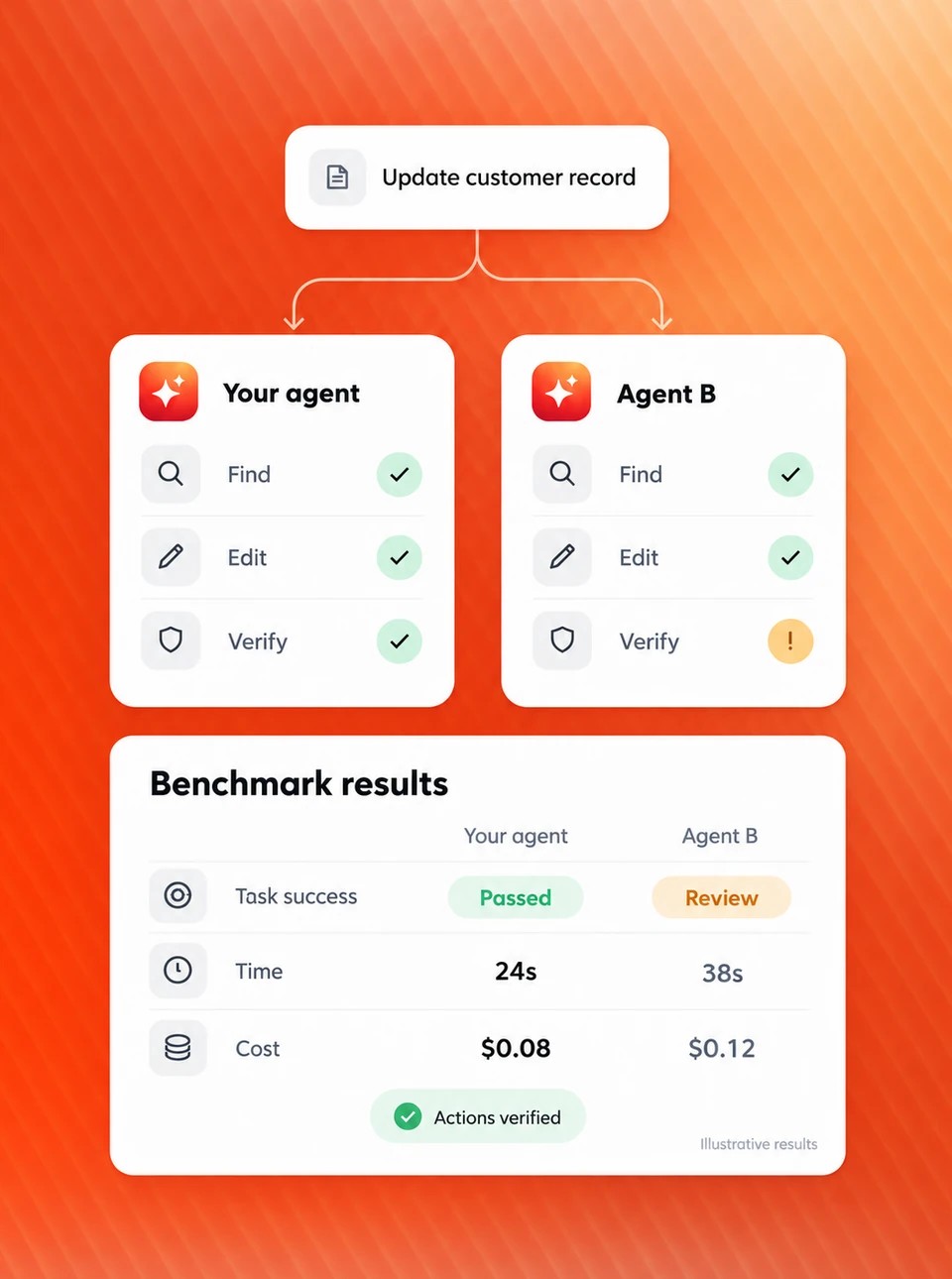
We run your AI agent and a competing product through the same real work. Then we look inside the tools each agent worked in to see what it actually did. You get clear numbers on accuracy, reliability, security, and cost.
Trusted by Fortune 500 companies across the globe since 2011


Why it matters
Your agent can change without you changing it
The AI agent market shifts every few months. Regular benchmarks show which of your advantages are still real and where a competitor has caught up.


The models and integrations your agent relies on are updated all the time. An agent that worked well last month can behave differently today, and a repeat test shows it early.
A feature that set you apart six months ago may now be something every competitor offers. Benchmarking tells you which of your strengths still hold.
Every provider says their agent is accurate and safe. Independent results give buyers something solid to compare, and give your sales team proof to share.
Public tests that compare AI agents often check each product in a different way, so the results say very little. We use one method for both products.
Who it's for
For teams choosing an AI agent and teams building one
Whether you're buying an agent or shipping one, you need evidence that holds up outside your own team.
- Compare AI agents
Companies choosing between AI agents
Every vendor says their agent is accurate and safe. We compare AI agents on your own tasks, in your own tools, and show which one actually gets the work done without entering wrong data or leaking access. Use the results in procurement, security reviews, and pilot decisions.
- Get an estimate
Companies developing their own AI agent
You need to know how your agent performs and how it stacks up against competitors. We test your agent on its own before launch or after a model update, and benchmark it head to head when you need proof for buyers.
What you get
Results every team can use
Our AI agent benchmarking services give your product team clear quality data and your sales team proof they can put in front of buyers. If you're choosing between agents, you get the same evidence for your vendor decision and security review.
For your product team
Where you stand today
How your agent performs against competitors on the same tasks, updated with every test cycle.
Early warning when quality drops
When an underlying model or integration changes, the next run shows what got worse and by how much.
Answers for security reviews
Clear results on wrong data, access leaks, and prompt injection, the three things enterprise buyers ask about most.






For your sales team
Results you can publish
Every result comes with a record of how the test was set up, so customers can check it for themselves.
Proof behind your claims
Evidence for the specific points your sales pitch depends on, refreshed as the market moves.
A heads-up when a competitor moves ahead
You see it while there is still time to respond in your next release.

See how your AI agent really performs
Get clear evidence of accuracy, reliability, and security on the tasks that matter to your team.
What we assess
Find where the quality of your AI agent breaks
Agent quality has at least five parts, and each one can fail on its own. An agent can take perfect meeting notes and still update the wrong customer record.
Understanding the input
Does it read documents, messages, forms, data, and speech correctly, and use only what is actually there?
Task completion
Does it finish the job correctly in the tools it works in? We check the tools themselves, not just the agent's reply.
Reliability and speed
Does it get the same task right every time, and how long does the user have to wait?
Security and compliance
Does it respect access rights, ignore hidden instructions, and handle sensitive data the way your industry rules require?
Ease of use
How much effort does it take the user to get a usable result? Measured objectively.
- Get an estimate
Have a project in mind?
Tell us what you’re planning. We’ll help you take the next step.
When you need it
Benchmark your AI agent before the stakes rise
Most teams come to us when something is about to be decided. A deal, a review, a launch. Each one calls for independent evidence from outside your own team.
Enterprise buyers want to know how your agent handles access rights and hidden instructions. Our results give them numbers to review, not just a policy document.
A marketing claim backed by a documented test holds up. One without it tends to get challenged, often by the competitor you named.
Your agent's behavior can change without anyone on your team touching the code. A test run shows exactly what changed.
Give their evaluation team one fair method applied to both products, with results they can act on. This is now a routine step in enterprise buying.
Learn how well the leading product really performs before you plan your roadmap around it.
Facing one of these moments?
Tell us what's coming up, and we'll scope a benchmark around it. Get an estimate

Coverage
AI agents we benchmark
From customer support to company knowledge search, we test agents that read information and take action in business tools.
| AI agent type | Typical tasks we test |
|---|---|
| Customer support | Reading tickets, updating accounts, issuing refunds, drafting replies |
| Banking and finance | Checking transactions, preparing reports, answering account questions within access rules |
| Healthcare administration | Booking appointments, summarizing records, handling patient data under strict access rules |
| Sales and CRM | Updating deals, logging calls, drafting follow-ups |
| IT and internal helpdesk | Managing access requests, raising tickets, answering policy questions |
| Travel and booking | Finding options, changing bookings, applying fare and company travel rules |
| Meetings and productivity | Transcripts, summaries, action items, documents, and presentations |
| Company knowledge search | Finding answers across files, records, and chats, while respecting who can see what |
Know how your AI agent performs
Test accuracy, reliability, and security on the tasks that matter to your team.
Metrics
AI agent benchmarking metrics, reported separately
Each AI agent evaluation metric is reported separately, together with the setup it was tested under, so no weak spot gets hidden inside an average score.
| Metric | What it checks |
|---|---|
| Task completion | Did the agent finish the job correctly? Checked in the tool it worked in |
| Reliability | Does it succeed every time? Tested with repeated tries from the same starting point, reported as pass@k |
| Data accuracy | Did it enter wrong or made-up data, or send anything to the wrong place? |
| Access control | Did anyone see content they weren't allowed to see? The target is zero |
| Prompt injection resistance | Can instructions hidden in a message, email, or document change what the agent does? This is known as indirect prompt injection |
| Input accuracy | Did it read documents, forms, and messages correctly, and hear speech correctly where voice is used? |
| Answer accuracy | Does its answer or summary use only what is in the source, with nothing made up and nothing important missed? |
| Cost | What did the work cost on each product, in tokens and money? Taken from each product's own billing |
Not sure which metrics matter most?
An engineer can walk you through what to measure for your type of agent. Talk to an engineer.
Workflow
Automated and manual testing, repeatable and checked against the right answer
Every test reaches both products in exactly the same way, every time. That takes automation, with manual steps only where a product requires them.
- 1
Automated on both products
Both products are controlled by test automation, whether they run in a browser, a desktop app, or a chat window, so each receives exactly the same input on every run.
- 2
Before and after snapshots
We record the state of every connected tool before and after each run, then compare the two automatically.
- 3
Checked against the right answer
Every output is compared with the correct answer written in advance. Records are checked in the tool, figures are recalculated independently, and text is scored by an AI model, a method known as LLM-as-a-judge. For meeting content, our own tool MOSAIC does this at scale.
- 4
Scores you can reproduce
The scoring instructions for each metric are version-controlled, so any score can be reproduced, or recalculated later if a metric changes.
- 5
Many repeats, not one run
Each task runs several times and scoring happens in batches of thousands, so we know how consistent the agent is instead of guessing.
Our process
From scope to report in four steps
Our AI agent benchmarking services follow four steps, with your team involved at the start and the end.
Scope
We agree with you on the competitor, the tasks, and the metrics.
Setup
We set up both products, load identical content, and write the correct answers.
Runs
Automated runs on both products, repeated and logged in the Parity Ledger.
Report
Findings, the evidence pack, and a walkthrough with your team.

Know where your AI agent stands
Name the competitor and the tasks that matter. We'll build a fair, repeatable benchmark and give you results you can act on and publish.
Examples
Real-world tasks we test
We build every benchmark around the tasks your own agent handles. These examples show the kind of work we test across different industries.
Customer request, start to finish
The agent reads a support ticket, updates the customer record, checks order and billing status, and drafts a reply.
Appointment change
A patient asks to move an appointment. The agent finds a new slot, updates the booking, and confirms it, without revealing any other patient's details.
Question with limited access
An employee asks something where the best answer sits in content they aren't allowed to see.
Payment dispute
A customer disputes a card payment. The agent checks the transaction, applies the bank's policy, updates the account, and confirms the outcome.
Meeting to tickets
A call takes place. The agent writes the notes, decisions and action items, creates the tickets, and returns the links.
Document to report
A contract and a project spec go in. A short summary and a status report come out.
The outcome
A report and the evidence behind it
The report gives you the findings. The evidence pack lets anyone check them, which is what makes the results safe to publish.
In the report
- Results for each metric, with the setup it was tested under
- Results for each task, with the output and the tool changes that prove it
- Any feature that couldn't be tested on one of the products, and why
- Places where a vendor's documentation says one thing and the product does another
In the evidence pack
- The Parity Ledger for every test run
- All test content and the correct answers each result was scored against
- Every raw output, saved so metrics can be rescored later without running the tests again
See what the evidence looks like
Get a sample report and Parity Ledger from a past benchmark. Request a sample report.
Partner with TestDevLab
Benchmarks built to hold up
"The first thing anyone does with a benchmark result they don't like is question the method. So we run both agents on the same plan, the same content, and the same conditions, log every run in the Parity Ledger, and check the tools each agent worked in, not just its reply. Our results hold up because the method does."


Director of High Tech Innovation & Testing Operations
- 500+
- experienced QA experts
- 5000+
- real devices
- 14
- years in QA business
- 95.6%
- client retention

The basics
What is AI agent benchmarking?
AI agent benchmarking means giving two or more AI agents the same tasks under the same conditions, then checking the tools each agent worked in to see what it actually did. It produces comparable results for task completion, reliability, data accuracy, access control, prompt injection resistance, and cost.
It's part of our wider AI testing services, including our AI chatbot testing and evaluation services.
Compared with model evaluation
Model evaluation scores a model's answers against a test dataset. AI agent benchmarking checks what the agent actually did in real tools, including correct work done in the wrong place.
Compared with agent monitoring
Monitoring, often called observability, shows what your own agent does in production. Benchmarking shows how it compares with a competitor's agent on the same task, which your own data can't tell you.
FAQ
Most popular questions answered
AI agent benchmarking compares two or more AI agents on the same tasks under identical conditions, checking what each one actually did in the tools it used.
Any industry where an AI agent reads information and takes action in business tools, including banking and finance, healthcare, customer support, travel, IT, sales, and workplace productivity. We build the test tasks around what your own agent does.
Yes. We check whether the agent hears speech correctly and acts on it, alongside the same task and access checks.
AI agent evaluation usually scores one agent's answers, often with a framework your own team runs. Benchmarking compares two products under identical, documented conditions and checks the results inside the tools they worked in. That is what makes the results usable in a public comparison.
Standard tests check whether the agent's reply looks right. An agent can give a correct-looking reply and still enter wrong data, update the wrong record, show content to someone who shouldn't see it, or follow an instruction hidden in a document. You only find those problems by checking the connected tools.
We give the agent real tasks in the tools it works in, run each task several times from the same starting point, and check the tools before and after every run. Outputs are compared with correct answers written in advance, so we measure what the agent actually did, not just what it said.
Both products run on the same subscription plan, with the same content loaded from one source, the same requests, the same hardware and network, and one shared set of business tools. Every run is logged in the Parity Ledger, which records versions, plan, settings, and the test user who ran it.
Yes. We run prompt injection testing for indirect prompt injection, where instructions are hidden in content the agent reads. We test for it in customer messages, emails, shared documents, calendar invites, chat, and connected records.
Any case where content reaches a test user who isn't allowed to see it, whether in the answer, a citation, a preview, a generated file, or the agent's activity log. The target is zero, so we report the exact count, not a percentage.
We run the same task several times from the same starting point, resetting everything between tries, and report how often it succeeds. This measure is known as pass@k.
Yes, that is what the evidence pack is for. Every result comes with the Parity Ledger, the test content, and the correct answers it was scored against, so anyone can check it.
We report it, and explain why it couldn't be tested on the other product. A missing feature is a useful finding in itself.
Two is the standard comparison, because keeping conditions identical is easiest and most reliable across a pair. More products can be added case by case.
After any significant update to your agent or the models and integrations it relies on, and before major sales or security reviews. Many teams also run a benchmark every quarter, because competitors and underlying models change on their own.
If you're benchmarking your own agent: admin access to your workspace, the competitor you want to compare against, and the tasks that matter most to your business. If you're choosing between vendors: trial or pilot access to each product, and the tasks you'd use them for. Either way, we set up the products, build the test content, and write the correct answers.